

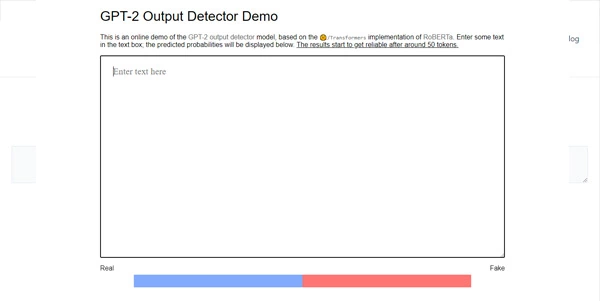
Verifying the authenticity of digital text is essential to combat automated misinformation. The GPT-2 Output Detector is an open-source model developed to analyze text sequences and calculate the probability that they were generated by a language model.
Quick Answer
GPT-2 Output Detector is an open-source detection tool developed by OpenAI to identify machine-generated text. It is ideal for educators, content editors, and platforms looking to verify text authenticity and detect early-generation AI content. The primary use case is analyzing short to mid-length text inputs, with the main advantage of offering transparent probability scoring without licensing restrictions.
Table of Contents
Full Introduction to GPT-2 Output Detector
As large language models like GPT-2 and its successors emerged, distinguishing between human writing and machine output became a critical challenge. In response, OpenAI released this detector as an early benchmark to help researchers track and verify AI generation.
Although optimized for GPT-2, the underlying RoBERTa-based architecture can detect markers of automated writing across various models. It is a foundational utility in the directory of AI detection tools, offering a transparent, code-level approach to content verification.
How Does it Work?
The GPT-2 Output Detector runs a text sequence through a fine-tuned RoBERTa model. Instead of relying on watermark patterns, it analyzes word predictability (perplexity) and sequence patterns typical of language models.
The model outputs a percentage score indicating the likelihood of the text being “Real” (written by a human) or “Fake” (generated by a machine). Because AI models tend to select highly probable word combinations, the detector flags repetitive phrasing and robotic sentence structures.
Key Features
- Probability Scoring: Displays live percentages for both human and machine origin.
- RoBERTa Foundation: Fine-tuned on the GPT-2 output dataset for high accuracy on similar model generations.
- Open-Source Access: Download the code and weights to host your own local detection instance.
- API Integration: Easily integrate the Python implementation into automated content moderation systems.
- No Character Limits: Run long text sequences locally without worrying about pricing caps.
Pros and Cons
Advantages
- 100% Free: Open-source project with no subscription fees or payload restrictions.
- No Cloud Dependency: Run it entirely offline to protect document confidentiality.
- Reliable Benchmark: Acts as a consistent, transparent tool for academic research.
Disadvantages
- Older Model Target: Specifically optimized for GPT-2, meaning it is less effective against modern models like GPT-4 or Claude.
- False Positives: Highly structured human writing (like technical documentation) can occasionally be flagged as AI.
Use Cases
Academic Integrity Verification
Educators can check student essays for early-generation machine writing to maintain classroom standards.
Content Moderation
Forum administrators can scan new posts automatically using the API to block automated spam and bot accounts.
Step-by-Step Tutorial
- Access the Tool: Open the hosted demo page or clone the GitHub repository locally.
- Input Text: Copy and paste the text segment (at least 50 words for optimal results) into the input area.
- Analyze: Run the detector model to process the text sequences.
- Review Score: Check the “Real” vs “Fake” percentages shown below the text box.
- Interpret: A high “Fake” score indicates a high probability of machine-generated origin.
Pricing and Licensing
The GPT-2 Output Detector is completely free under open-source terms:
| Option | Cost | Details |
|---|---|---|
| Open-Source Code | Free ($0) | MIT/Apache license, download from GitHub, self-host anywhere. |
| Hosted Demos | Free ($0) | Community-hosted web pages for quick test runs. |
Price details may change over time. It is highly recommended to check the official repository for latest updates.
Comparison with Competitors
| Feature | GPT-2 Output Detector | GPTZero | Copyleaks |
|---|---|---|---|
| Modern AI Detection | Low (Legacy) | High | Very High |
| Pricing | Free (Open-Source) | Paid Plans | Paid Plans |
| Data Privacy | Excellent (Run locally) | Cloud-dependent | Cloud-dependent |
Who Should Use the Detector?
Who Should Use It?
It is perfect for AI researchers studying model predictability, developers building local moderation pipelines, and hobbyists verifying legacy text files.
Who Shouldn’t Use It?
Professional editors and educators who need to detect advanced writing models (like ChatGPT/GPT-4, Gemini, or Claude) should use newer enterprise tools.
Best Alternatives
- GPTZero: A modern industry standard designed for university and educational environments.
- Copyleaks: A highly accurate enterprise detector that supports multiple languages.
- Originality.ai: A paid platform targeting web publishers to identify modern AI content.
Frequently Asked Questions
Can it detect ChatGPT (GPT-3.5 or GPT-4) output?
It is highly unreliable for newer models. ChatGPT uses more advanced generation techniques that bypass this legacy detector.
Is there a character limit?
When run locally on your own machine, there are no character limits or usage quotas.
How accurate is the GPT-2 Output Detector?
It is very accurate for text generated by GPT-2, but its effectiveness drops significantly with newer models.
Does it save my submitted text?
If you run the model locally, your data never leaves your computer, making it 100% private.
Why did it flag my human-written text as AI?
If your text is highly structured, uses repetitive formulas, or is short, the model may misidentify it (false positive).
What programming language is it written in?
The core detection code is written in Python, utilizing the Hugging Face Transformers library.
Can I run it on Windows?
Yes, you can run the detector on Windows, Linux, or macOS by setting up a Python environment.
Who created this tool?
The detector model was trained and released by OpenAI alongside their research on GPT-2.